
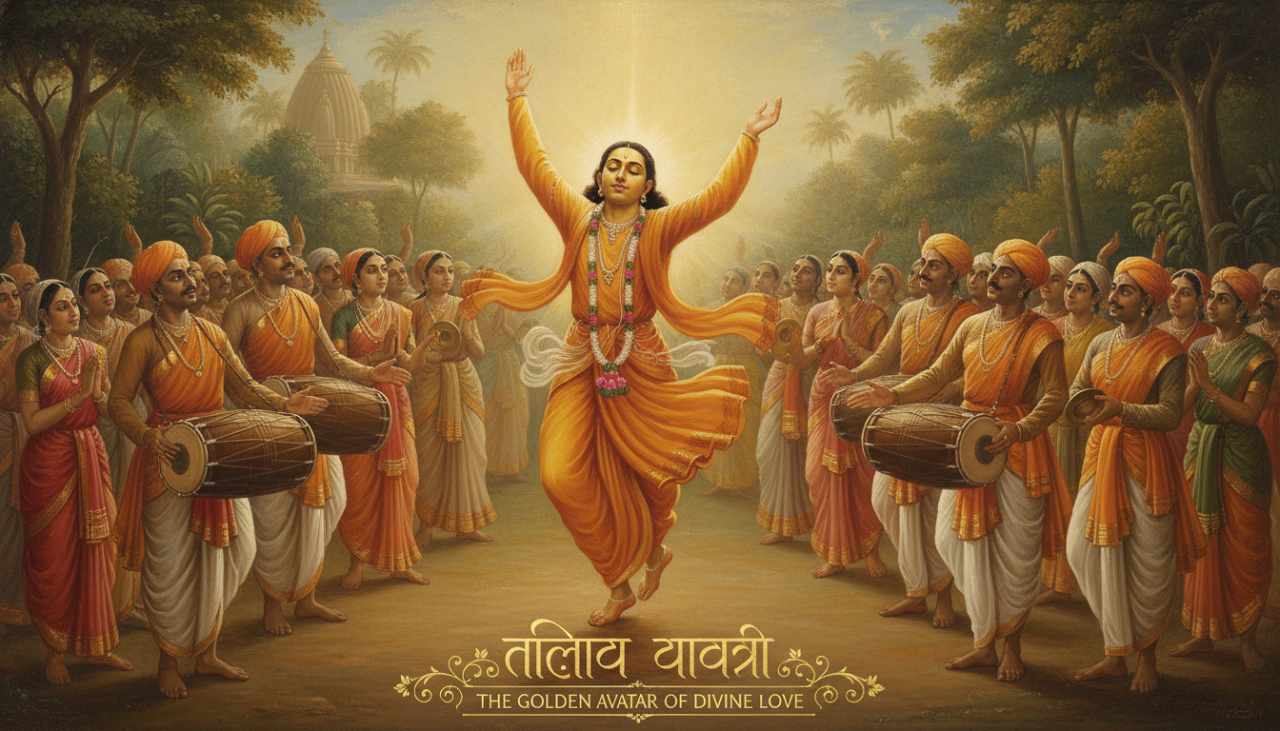
In the late 15th century, amidst the cultural and religious turbulence of medieval India, a figure emerged who would forever alter the spiritual landscape of the world. Born under a full lunar eclipse in 1486, Sri Chaitanya Mahaprabhu is revered by millions not merely as a saint, but as the combined manifestation of Radha and Krishna. His appearance marked the beginning of a spiritual renaissance that prioritized pure devotion over rigid caste structures and dry intellectualism.
While history books often categorize him as a Bengali social reformer, theological texts describe him as the “Golden Avatar” due to his radiant golden complexion. His life was a dramatic tapestry of scholarship, divine madness, social civil disobedience, and deep theological revelation. Today, the echoes of his teachings are heard in every major city of the world through the chanting of the holy names.
Understanding the life of Chaitanya requires navigating through his transformation from a proud scholar into a humble devotee, a journey that re-established the Bhakti Yoga tradition as the prime benediction for humanity in the current age.
The Early Years: Nimai Pandit of Navadvipa
Sri Chaitanya was born as Vishvambhara Mishra in Mayapur, a quarter of the city of Navadvipa in Bengal. Navadvipa was essentially the Oxford of medieval India, a hub of logic, Sanskrit grammar, and philosophical debate. Affectionately called “Nimai” by his mother Sachi Devi because he was born under a Neem tree, the boy displayed supernatural intelligence from infancy.
By his teenage years, Nimai had established himself as an unconquerable scholar. He opened his own school of logic (Tol) and became famous as “Nimai Pandit.” At this stage, his focus was purely academic. He took pleasure in defeating visiting scholars in public debates, dismantling their arguments with intricate logic only to reconstruct them again. He was the embodiment of intellectual prowess, yet he displayed little interest in devotional service.
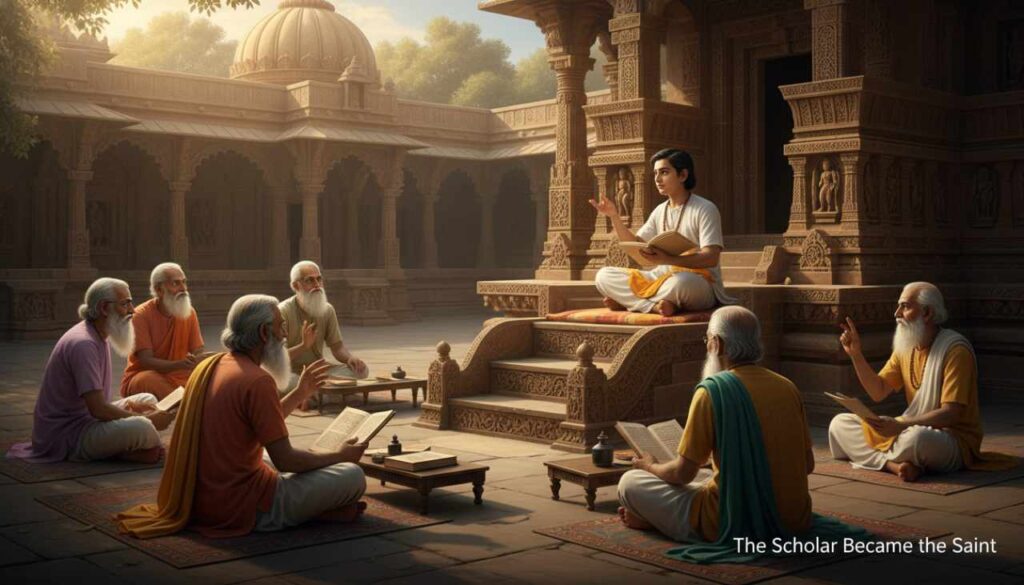
It was during this period that he defeated the renowned Kashmiri scholar, Keshava Kashmiri, who was believed to be invincible. However, despite his arrogance as a logician, those around him noted a distinct, magnetic charm. His influence was growing, but the true purpose of his descent had not yet been revealed. The seeds of Gaudiya Vaishnavism were present but dormant, waiting for a catalyst to sprout.
The Transformation in Gaya
The pivotal turning point in the life of Chaitanya occurred when he traveled to Gaya to perform rites for his deceased father. There, he met the ascetic Ishvara Puri. In a moment of divine surrender, the proud scholar Nimai fell at the feet of Ishvara Puri and begged for initiation.
Upon receiving the mantra, Nimai was transformed. The arrogance of the logician vanished, replaced by an intense, overwhelming love for Krishna. He returned to Navadvipa a changed man. He closed his school, telling his students that he could no longer teach grammar rules that did not lead to Krishna. Instead of debating logic, he began to chant, weep, and dance in ecstasy.
The Birth of the Sankirtana Movement
Upon his return, Nimai began the Sankirtana movement—the congregational chanting of the holy names of God. This was a radical departure from the solitary meditation practiced by yogis of the past. He declared that in the current age of quarrel and hypocrisy (Kali Yuga), the only means of deliverance was the chanting of the Hare Krishna mantra.
He gathered his close associates at the house of Srivasa Thakura for nightly kirtans. These sessions were initially private, characterized by profound symptoms of spiritual ecstasy. However, the movement soon spilled into the streets. Chaitanya Mahaprabhu democratized spirituality, allowing women, lower castes, and the socially ostracized to participate in the chanting, breaking the monopoly of the priestly caste.
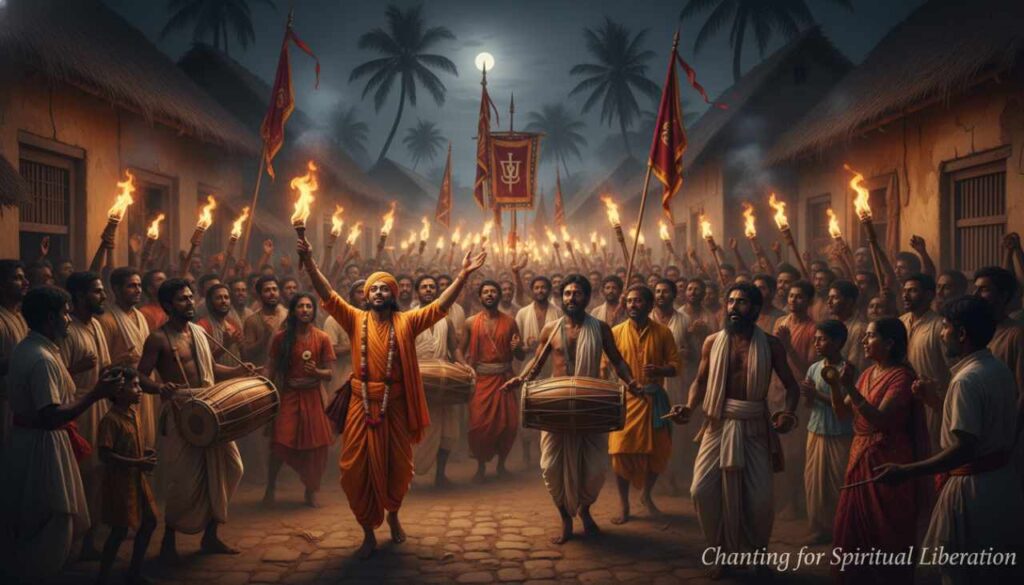
This social disruption drew the ire of the Chand Kazi, the local Muslim magistrate, who banned the loud chanting. in a historic act of non-violent civil disobedience—predating Gandhi by centuries—Chaitanya led a massive procession of thousands of torch-bearing chanters to the Kazi’s palace. Overwhelmed by the crowd and Chaitanya’s spiritual potency, the Kazi not only lifted the ban but promised that his lineage would never hinder the Sankirtana movement again.
Renunciation and Travel
At the young age of 24, perceiving that his role as a householder was limiting his ability to spread the message of devotion widely, Nimai accepted the renounced order of life (sannyasa). He was named Sri Krishna Chaitanya. This decision devastated his mother, Sachi, and his wife, Vishnupriya, yet it was a necessary sacrifice for the broader welfare of humanity.
After taking sannyasa, Chaitanya Mahaprabhu traveled extensively. He toured South India for six years, visiting major temples and debating philosophers. He converted Mayavadi (impersonalist) sannyasis, including the great Sarvabhauma Bhattacharya in Jagannath Puri and Prakasananda Sarasvati in Varanasi, to the path of personal devotion.
His travels were not just about conversion but about excavation. In Vrindavana, he identified the lost holy sites associated with Lord Krishna’s pastimes. He instructed his disciples, the Six Goswamis, to excavate these places, build temples, and write scriptures that would scientifically establish the theology of the Bhakti Yoga tradition.
The Philosophy: Achintya Bheda Abheda
Sri Chaitanya Mahaprabhu did not merely focus on sentiment; he established a robust philosophical conclusion known as Achintya Bheda Abheda Tattva—the inconceivable simultaneous oneness and difference between the soul and God. This philosophy harmonized the duality of the Vaishnavas (who see God and the soul as distinct) and the monism of the Advaitins (who see them as one).
He taught that while the soul is qualitatively one with God (made of the same spiritual energy), it is quantitatively minute and distinct. This relationship allows for an eternal exchange of love, which is the highest goal of life, surpassing even liberation (moksha).
The Final Years in Puri
The last 18 years of Sri Chaitanya’s life were spent in Jagannath Puri. For the final 12 years, he rarely left his room, known as the Gambhira. Here, he experienced the deepest internal moods of Radha’s separation from Krishna. His associates recorded that his body would undergo impossible transformations due to spiritual ecstasy, sometimes lengthening or contracting.
Mahabhava, the highest stage of divine love, characterized these years. He was constantly absorbed in the chanting of the holy names, demonstrating the ultimate perfection of the Gaudiya Vaishnavism path. He left only eight written verses, the Sikshastakam, which summarize his entire mission emphasizing humility, tolerance, and the exclusive desire for unconditional devotional service.
A Global Legacy
Sri Chaitanya Mahaprabhu predicted that the holy names of Krishna would be chanted in every town and village of the world. For centuries, this seemed impossible, as the movement remained largely within India. However, in 1965, a dedicated follower in Chaitanya’s lineage, A.C. Bhaktivedanta Swami Prabhupada, traveled to the West and established the International Society for Krishna Consciousness (ISKCON).
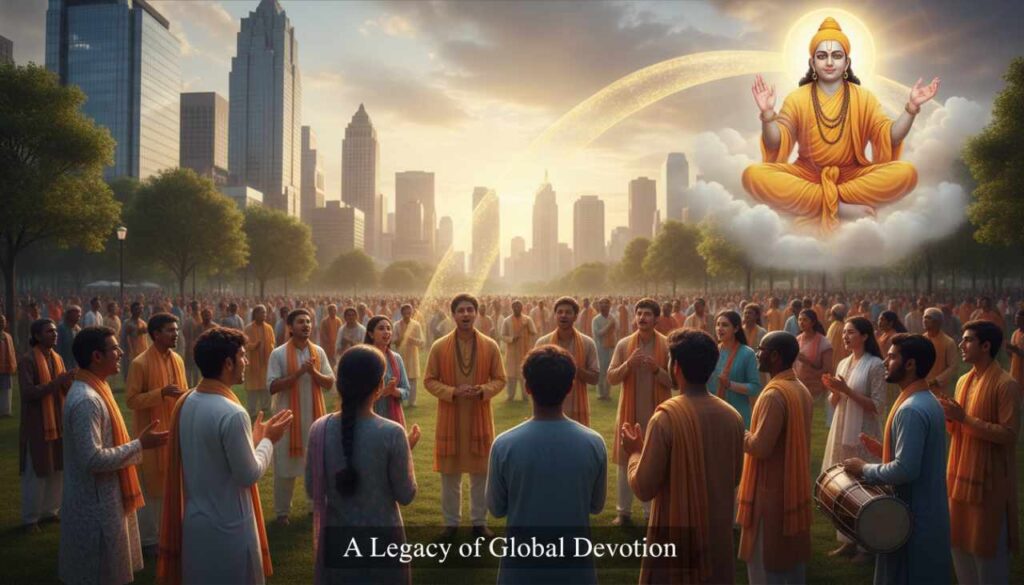
Today, the Hare Krishna mantra is familiar globally, from the streets of London to the villages of Russia. The legacy of Sri Chaitanya is not just a historical footprint; it is a living, breathing spiritual culture that continues to offer solace and direction to millions. His life remains the gold standard for the Bhakti Yoga tradition, teaching that divine love is the birthright of every soul, regardless of background, race, or caste.
Summary
The life of Sri Chaitanya Mahaprabhu was a divine orchestration aimed at reclaiming fallen souls. By introducing the Yuga-Dharma (the duty of the age) as the chanting of the holy names, he provided a simple yet sublime process for self-realization. Whether viewed as a social revolutionary or God Himself, his influence on human consciousness is undeniable.
FAQs
Q.Who was Sri Chaitanya Mahaprabhu?
Sri Chaitanya Mahaprabhu was a 15th-century Indian saint and social reformer considered by his followers to be the Golden Avatar of Lord Krishna. He founded Gaudiya Vaishnavism and popularized the congregational chanting of the Hare Krishna mantra.
Q.What is the Sankirtana movement?
The Sankirtana movement is the congregational chanting of the holy names of God, specifically the Hare Krishna mantra. Initiated by Chaitanya Mahaprabhu, it is considered the most effective method for spiritual realization in the current age (Kali Yuga).
Q.What philosophy did Chaitanya Mahaprabhu teach?
He taught the philosophy of ‘Achintya Bheda Abheda,’ which translates to inconceivable simultaneous oneness and difference. This doctrine holds that the soul is qualitatively one with God but quantitatively distinct, allowing for an eternal, loving relationship.
Q.Did Sri Chaitanya write any books?
Sri Chaitanya Mahaprabhu left only eight verses known as the ‘Sikshastakam.’ However, he instructed his disciples, the Six Goswamis of Vrindavana, to write extensive theological texts based on his teachings to establish the movement philosophically.
Q.Why is he called the Golden Avatar?
He is referred to as the Golden Avatar because of his radiant golden complexion. Scripturally, this is interpreted as Krishna appearing with the mood and complexion of Srimati Radharani, his eternal consort.
Q.How did Chaitanya Mahaprabhu impact the caste system?
He challenged the rigid caste system by allowing anyone, regardless of birth or social status, to become a brahmana or spiritual leader through devotion to God. He emphasized that spiritual elevation is based on behavior and devotion, not lineage.